

So, you’ve decided to learn Arabic. That initial spark of excitement is still there – the idea of reading beautiful script, understanding a rich culture, maybe even chatting with locals on a future trip. But then, the questions creep in. A whole new alphabet? Sounds that don’t exist in English? What about the grammar? It’s easy to feel overwhelmed.
What if I told you it doesn’t have to be that hard? The journey to understanding Arabic can be surprisingly straightforward – if you ditch the old-school, brute-force methods and work with your brain instead of against it.
Ready to Master Arabic?
Your trusted virtual Arabic learning center. Courses from Beginner (A1) to Proficient (C2), aligned with the CEFRL and tailored to your goals.
Pre-register NowSecure your spot. Begin your journey today.
The Alphabet
For many, the Arabic script is the first and biggest hurdle. Those elegant, flowing letters look more like art than a writing system you can learn. The common advice is to memorize all 28 letters before doing anything else.
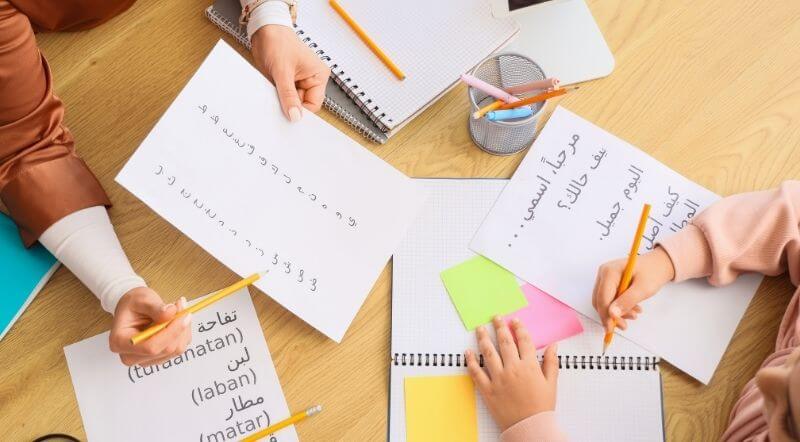
Arabic script is actually logical. Most letters are variations of a basic shape, changing slightly depending on their position in a word. The trick isn’t a pre-course memorization marathon. Start by learning small, common groups of letters – like those for “b,” “t,” and “th” sounds, which share a core form. Learn them in context, within simple words, right from your first lesson. This way, you’re not just memorizing abstract symbols; you’re seeing how they work. You build confidence immediately because you’re actually reading something, however small. It turns a daunting task into a series of manageable, rewarding wins.
Which Arabic Are We Even Talking About?
Here’s something crucial that trips up beginners: there isn’t just one “Arabic.”
You have Modern Standard Arabic (MSA) – this is the formal, written language. It’s used in news broadcasts, official documents, literature, and formal speeches across the Arab world. It’s your key to reading and understanding the broader Arabosphere.
Then you have the dialects – the spoken languages of everyday life. The Egyptian dialect is a popular starting point thanks to its widespread presence in film and music. Levantine (spoken in Syria, Lebanon, Jordan, Palestine) is another fantastic choice for its relative clarity and media appeal. Gulf dialects, Maghrebi dialects – each has its own flavor.
So, which one should you pick?
- Goal: Reading news, literature, or working in diplomacy/academia? Focus on MSA.
- Goal: Conversing, traveling, or connecting with friends and family? Pick a dialect.
- Ambitious? Many learners do both in tandem. They use MSA as the grammatical backbone and a dialect for practical conversation. A good course will often blend them intelligently. Don’t let this choice paralyze you. Pick a direction and start walking. You can always adjust your path later.

Forget «Fast» Think «Steady»
The dream of “learning Arabic fast” often leads to binge-studying on weekends, which is about as effective as cramming for a test. You might remember something for a day, but it won’t stick.
Our brains are built for consistency, not intensity. What truly works is short, daily contact. Twenty minutes every single day beats a four-hour session once a week, every time.
How do you make this happen without it feeling like a chore?
- Steal moments. Listen to an Arabic pop song or a short podcast episode while you commute or cook. Don’t stress about understanding every word; just let the sounds and rhythm wash over you. This is called passive listening, and it’s gold for training your ear.
- Switch your digital world. Change your phone’s language to Arabic for a week. You already know where everything is, so you’ll associate the Arabic words with their functions effortlessly. إعدادات will forever mean “Settings.”
- Label your life. A sticky note on the fridge (بَرّاد), the mirror (مِرْآة), the window (نَافِذَة). It’s simple, visual, and surprisingly effective for building core vocabulary without flashcards.
This isn’t about adding more study time; it’s about weaving the language into the fabric of your day. It stops being a “subject” and starts becoming a part of your environment.

Talk to Yourself
The fear of speaking is universal. What if I sound silly? What if I make a mistake and someone laughs?
The best way to beat this fear is to speak where no one can hear you – yet. Narrate your life in Arabic, in your head or out loud. “I’m drinking coffee.” “This email is long.” “Where are my keys?” When you hit a word you don’t know, you look it up. That moment of search and recall burns it into your memory far better than reviewing a list.
This self-talk does two powerful things: it builds a mental habit of thinking in Arabic phrases, not just translating from English, and it makes your first real conversation feel like less of a leap into the void. You’ve already practiced.
Ready to Master Arabic?
Your trusted virtual Arabic learning center. Courses from Beginner (A1) to Proficient (C2), aligned with the CEFRL and tailored to your goals.
Pre-register NowSecure your spot. Begin your journey today.
Communication
Apps and books are great tools, but they have limits. At some point, you need real human interaction. This is where the magic happens – and it’s more accessible than ever.
A tutor is your safe space to make mistakes, ask the weird questions (“How do you really say ‘chill out’ in Amman?”), and get instant feedback on your pronunciation.
That feedback loop is irreplaceable. A tutor can hear the slight difference in your ح (a deep “h” sound from the throat) that an app might miss. They can explain why a phrase from a textbook sounds a bit off in casual conversation. This interaction transforms your Arabic from a theoretical exercise into a living, breathing skill.

Celebrate the Tiny Victories
Learning a language is a marathon with many, many sprints. You’ll have breakthroughs and you’ll have plateaus. The key to staying motivated isn’t just focusing on the distant finish line (fluency); it’s celebrating every single flag along the way.
That first time you read a restaurant name correctly. The moment you understand the main idea of a song lyric. The thrill of successfully asking for directions and understanding the answer. These small wins are your fuel. They’re proof you’re moving forward.
So, what’s the fastest and easiest way to learn Arabic? Honestly, it’s the path you stick to. It’s the one built on smart, gradual learning instead of cramming, on daily whispers instead of weekly shouts, and on the courage to start speaking – even if it’s just to yourself at first.
Your adventure with Arabic doesn’t require a perfect plan. It just needs a start. Why not make today the day you learn your first small group of letters, or listen to one Arabic song? The door is right there. You’ve already got your hand on the knob.
Ready to Master Arabic?
Your trusted virtual Arabic learning center. Courses from Beginner (A1) to Proficient (C2), aligned with the CEFRL and tailored to your goals.
Pre-register NowSecure your spot. Begin your journey today.