

You know what always surprises me about the Arab countries? You can live in an Arab country, like the UAE, for years speaking only English. But say just one single Arabic word and everything changes. It’s like you’ve pressed an invisible “friendliness +100” button. Whether the market vendor, the strict concierge at the office, or the taxi driver, a little light turns on in their eyes; not because you said something clever, but simply because you tried.
I won’t burden you with lists of 100 phrases. Let’s just talk about five; but five that work every single time. And most importantly, I’ll tell you exactly when to use which one, so you don’t end up in an awkward spot.
Ready to Master Arabic?
Your trusted virtual Arabic learning center. Courses from Beginner (A1) to Proficient (C2), aligned with the CEFRL and tailored to your goals.
Pre-register NowSecure your spot. Begin your journey today.
Essential Arabic Phrases
Phrase One, your base: “Marhaba مرحبا.”
This is your “hello” for every occasion. You walk into a café, you say “Marhaba.” You meet a colleague in the morning, you greet them with “Marhaba”. You say “Marhaba” to the security guard and he’s already nodding at you like you’re one of his own.- Pronunciation: Just say “mar-ha-ba,” stressing the “ha.” Exhale that “ha,” almost like you’re trying to fog up a mirror.
More Important Than “Hello”: “Shukran شكراً.”
“Thank you”: That’s your superpower. Arab culture is built on generosity. Not saying “thank you” is almost disrespectful. The cashier gave you change, say Shukran. The taxi driver got you to your destination, get out of the car saying Shukran. The cleaner vacuumed the hallway, don’t forget to say Shukran.
- Key nuance: In response, you’ll hear “‘Afwan عفواً.” Remember this word! If someone thanks you, say “‘Afwan.” If you didn’t catch what someone said, also “Afwan?” with a questioning tone. A magic word.
- Enhanced version: If someone bought you coffee or helped you a lot, add: “Shukran jazeelan جزيلاً”. That’s “thank you very much.”
Phrases For Different Situations
When You Need to Find Something. The Rescue Word: “Ayn أين?”
Lost in the endless corridors of a mall? Need to find a bathroom urgently? Your word is “Ayn?”. It means “where?”
- How to use it: Just add what you’re looking for. Point to a spot on the map and ask: “Ayn al-hammam أين الحمّام?” (Where is the bathroom?). Or: “Ayn Souq Al Khaled أين سوق الخالد?” (Where is Al Khaled Market?). People will start animatedly pointing the way. The key is to remember to say “Shukran” after.
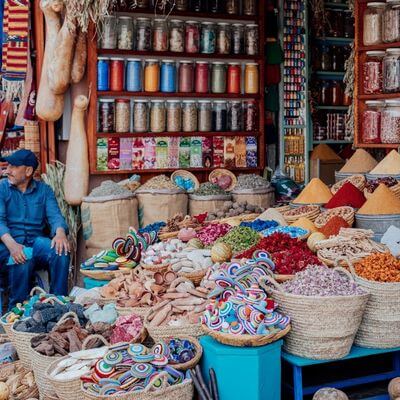
If You’re at a Market. The Ritual Called “Bikam بِكم?”
Markets or Souqs (السوق) are a big part of the Arab identity. Souqs reconnect people to their traditions, keeping these alive. There, different rules apply. The first price a vendor quotes is the start of a conversation, not the end.
- You see an item you like. Ask: “Bikam hatha?” (“bi-kam ha-tha بِكم هذا?”) – “How much is this?”
- You hear the price. Don’t nod right away. Smile, shake your head slightly and say: “Ghali!” (“gha-lii غالي!”). This means: “Expensive!” This is NOT rude. It’s a required part of the dance, for you’re showing you understand the rules.
- Then you can make your offer: “Mumkin bi-50 ممكن بٍـخمسين?” (“Can I have it for 50?”). Or just say “Shukran” and take a step back from the stall. Often, that’s when you’ll hear the final, reasonable offer.
The Secret Cultural Weapon. “Insha’Allah إنشالله”
This is perhaps the most important word for understanding the ِArab mindset. “Insha’Allah” means “if God wills it.”
- When to ALWAYS use it: When talking about any future plans. Not “See you tomorrow,” but “See you tomorrow, insha’Allah.” Not “The documents will be ready by Wednesday,” but “The documents will be ready by Wednesday, insha’Allah.”
- Why it matters: Without this word, your plans can sound like a presumptuous demand or an empty promise. “Insha’Allah” is about humility, acknowledging that not everything is in our hands. Everyone uses it, from the taxi driver to the CEO. It’s the key to showing respect.

So, Do I Have to Memorize All This Now?
Absolutely not. Pick just one word today. For example, “Marhaba.” And start using it. Tomorrow, add “Shukran.”
Try going to a market this week and just once ask “Bikam hatha?” See what happens. Chances are, you’ll pay a little less, and more importantly, you’ll get a story and a smile.
The most important thing is to not stay silent out of fear of making a mistake. Here, your “mar-ha-ba” with a heavy Australian accent will generate a hundred times more warmth than any other complex expression. Because it’s an attempt. And that is valued here.
So, your “Marhaba” and “Shukran” are already working. The vendors are smiling, the guards are nodding. Time to go further. Let’s imagine a typical day and “unwind” it with new words. It’s like I’m right next to you, whispering: “Now say this.”
Morning: More Than Just “Good Morning”
You walk into your favorite café for a karak. The barista already recognizes you.
- Instead of just “Marhaba,” you can toss out a “Sabah al-khayr صباح الخير”, the classic “good morning.” They’ll reply with “Sabah an-noor صباح النور”, which means “morning of light.”
- When ordering, be specific with the quantity. Numbers are your friends. “Wahid, min fadlik واحد من فضلك”, “One, please.” (Wahid واحد = 1, Ithnain إثنين = 2, Thalatha ثلاثة = 3).
Afternoon: At the Office, Shopping, and Other Important Nuances
Situation 1: You need to ask a colleague for something or apologize.
“Sorry” isn’t just one phrase. There are two, for different occasions.
- “Afwan عفواً / Asifa آسف/ آسفة”: Say this if you accidentally bumped into someone, are a minute late, or interrupted someone or something. It’s a light “my bad.”
- “Uuthran عذراً”: Use this if the mistake is a bit more serious and you want to defuse the tension. Say it with a smile.
Situation 2: You’re in a store (not a market).
No haggling here, but there are specific phrases.
- Not just “Bikam?” but “Bikam hatha, min fadlik بٍكم هذا، من فضلك?”, meaning “How much is this, please?” “Min fadlik” softens any request.
- Want to try something on? “Mumkin An Ujarrib ممكن أن أجرّب?”, which means “Can I try it?”
- Deciding whether to buy? Say “Sa Ufakkir Kalilan سأفكّر قليلاً, meaning “I’ll think for a bit.” This is a polite way to avoid a direct “no,” and they’ll leave you alone.
Ready to Master Arabic?
Your trusted virtual Arabic learning center. Courses from Beginner (A1) to Proficient (C2), aligned with the CEFRL and tailored to your goals.
Pre-register NowSecure your spot. Begin your journey today.
Evening: Restaurant, Taxi, and Wrapping Up the Day
At a Restaurant:
- To get the waiter’s attention, don’t shout “Hello!” Calmly say “Law samaht لو سمحت”, “Please” (meaning “if you would be so kind”).
- Everything was amazing, and you want to compliment the chef? Say “El-taam lazeez jiddan الطعام لذيذ جدّاً”, which means “The food is very delicious.” After this, you’ll likely receive a compliment from the house.
In a Taxi or Navigating:
You already know “Ayn?”. Now let’s get specific.
- “Ilal yameen إلى اليمين”, “To the right.” “Ila shimal إلى الشمال”, “To the left.” “Ilal amam إلى الأمام!”, “Straight!”
- If you want the driver to go calmly and not rush, say “Ala mahl على مهل”, “Slowly.” And to hurry up, you already know, “Yalla!” or “Bi souraa بسرعة”.
The Grand Finale of the Day
When saying goodbye in the evening, don’t just say “Bye.” Say “Ma’a as-salama مع السلامة”, “Go in peace.” It’s a warm, beautiful wish.
How to integrate all this into your life?
Don’t learn it all at once. Take one scenario per week. For example, “Week of Numbers and Orders.” Practice “wahid, ithnain, thalatha” at the café. Next week would be “Week of Apologies”: “Afwan” and “Uuthran.”
Remember, even if you mix up “afwan” and “uuthran,” the most important thing is the attempt and the smile. Every new word is another little key. And it doesn’t open a place, it opens a mood. Yalla, give it a try!

FAQ
Popular Questions About Arabic in the UAE
When you start learning a language in a new country, questions naturally arise. Below are answers to the most common ones, based on real-life experience in the Emirates.
1. How necessary is Arabic for living in the UAE?
You can manage without it, but knowing the basics is very valuable. Business and daily life in the UAE’s major cities are fully conducted in English. You will be able to handle all work and everyday matters. However, a few key Arabic phrases are less about necessity and more about your pass to a deeper cultural layer. It’s a sign of respect that locals immediately notice and appreciate. Such phrases help transform standard interactions into warmer, more personal exchanges.
2. How quickly can one learn basic phrases for daily communication?
The basics take a few days; confidence takes a few weeks. Mastering Arabic perfectly is complex, but our approach is different. To memorize 10-15 of the most important phrases (greetings, thanks, essential questions), a few focused sessions are truly enough. What’s more critical than speed is consistency. Short but regular practice (for example, 10-15 minutes a day) and, most importantly, using the phrases in real situations yield immeasurably greater results than rare, long study marathons. A language lives when it is spoken.
3. Will these phrases be understood in other Arabic-speaking countries?
Yes, in most cases. Phrases like the greeting “As-salamu alaykum” and the thank you “Shukran” are standard across the Arab world. Some expressions in our list (e.g., “Shu el-yadeed?”) belong to the dialect common in the Gulf states and the Levant. In Cairo or Rabat, you will also be understood, perhaps with a smile noting your “Emirati” accent, which only adds positivity to the conversation.
4. Can I rely entirely on translation apps?
They are useful as assistants but poor as replacements. Apps are helpful in complex or unfamiliar situations. However, they cannot replace live communication. A personally spoken phrase is a gesture that shows your interest and respect for the culture. Furthermore, apps can fail without an internet connection, in noisy environments, or when you need to react instantly. Your own small vocabulary is the most reliable tool.
5. What should I do if, in response to my Arabic phrase, the other person switches to English?
Don’t be embarrassed. This is common practice. Often, people switch to English out of politeness, wanting to make communication easier for you. The best tactic is to continue in Arabic with a smile or say: “Ata’allam al-arabiyya أتعلّم العربيّة” (“I am learning Arabic”). In the vast majority of cases, this elicits approval and support, and the interlocutor will be happy to help you practice, perhaps by slowing down or simplifying their speech.
6. Are there topics or phrases one should avoid?
It’s advisable to stick to neutral and polite topics. As in any culture, for comfortable conversation, it’s best to avoid spontaneous discussions of politics, religion, or personal matters unless you are explicitly asked about them. The phrases from our guide are a safe and effective foundation for positive interaction, demonstrating your politeness and interest without the risk of crossing invisible boundaries.
Ready to Master Arabic?
Your trusted virtual Arabic learning center. Courses from Beginner (A1) to Proficient (C2), aligned with the CEFRL and tailored to your goals.
Pre-register NowSecure your spot. Begin your journey today.