

Reaching an intermediate level in Arabic often feels like standing at the edge of a plateau. You can introduce yourself, order food, and follow simple conversations, yet real fluency still feels far away. At L’arabe maîtrisé, we hear this from learners all the time, and it is one of the main reasons we designed our intermediate Arabic course around bridging that exact gap, moving students from basic comprehension to genuine, confident communication.
Why the Intermediate Stage Feels So Different
Beginners often experience quick, visible progress. New words, new sounds, and new grammar patterns arrive constantly, and every lesson feels like a clear step forward. At the intermediate stage, progress becomes less obvious, even though a great deal is actually happening beneath the surface.
This is the point where learners start engaging with longer sentences, more nuanced grammar, and vocabulary tied to specific contexts rather than simple daily phrases. It is also where many people quietly plateau, not because they have stopped learning, but because the challenges have shifted in a way that basic study habits no longer address.
What Makes Intermediate Arabic Genuinely Challenging
A few specific hurdles tend to appear consistently once learners move past the beginner stage.
- Understanding native speed speech, which moves far faster than the carefully paced audio used in early lessons
- Navigating verb conjugations across different tenses and moods without translating everything mentally first
- Building vocabulary broad enough to discuss topics beyond everyday routines
- Reading longer texts without needing to stop at every unfamiliar word
- Forming responses spontaneously, rather than relying on memorized phrases
None of these challenges are signs of failure. They are simply part of what it means to move from recognizing Arabic to actually using it.
How an Intermediate Arabic Course Should Be Structured
A course built for this stage needs to do more than add new vocabulary lists. It needs to reshape how a learner interacts with the language altogether. Our intermediate Arabic course focuses on this shift directly, moving away from rigid memorization and toward practical, contextual use of the language.
Grammar That Connects to Real Communication
At this stage, grammar stops being an abstract set of rules and starts becoming a tool for expressing more specific ideas. Instead of simply learning verb forms in isolation, intermediate learners benefit from seeing grammar applied inside realistic conversations, where tense, mood, and sentence structure actually change the meaning of what is being said.
Vocabulary Expansion Beyond Daily Basics
Beginner vocabulary tends to revolve around greetings, numbers, and simple needs. Intermediate learners need a wider net, covering topics like work, opinions, current events, and abstract ideas. This expansion is what eventually allows a learner to hold a conversation that goes beyond the surface level.
Listening Comprehension at a Natural Pace
One of the clearest markers of intermediate progress is the ability to understand Arabic spoken at a normal, unslowed pace. This requires consistent exposure to natural speech patterns, not just carefully enunciated practice material, which is why listening work at this stage looks noticeably different from what beginners typically experience.
Practical Ways to Practice Outside the Classroom
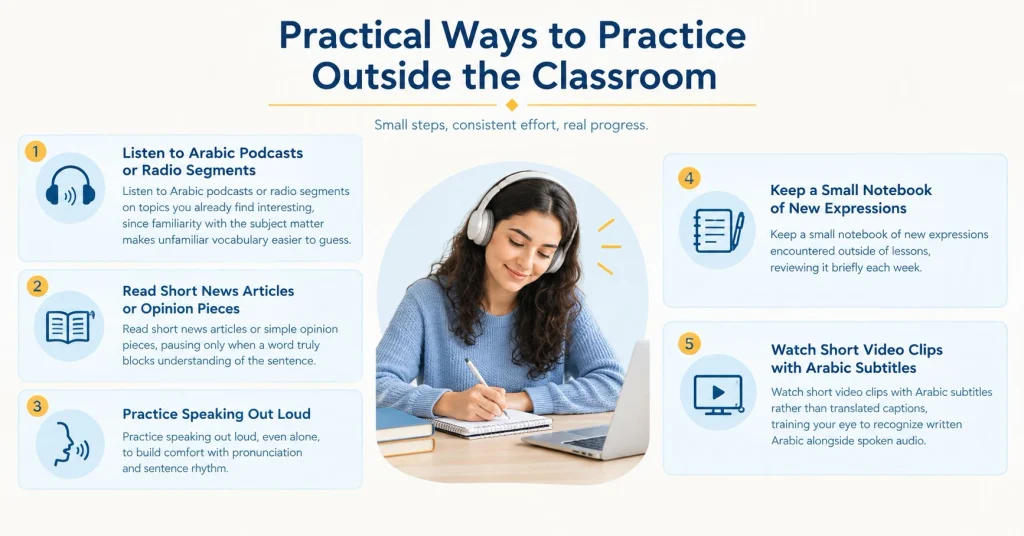
Classroom instruction gives structure, but consistent exposure between sessions is where a lot of intermediate progress actually happens. A few methods tend to work particularly well at this stage.
- Listen to Arabic podcasts or radio segments on topics you already find interesting, since familiarity with the subject matter makes unfamiliar vocabulary easier to guess
- Read short news articles or simple opinion pieces, pausing only when a word truly blocks understanding of the sentence
- Practice speaking out loud, even alone, to build comfort with pronunciation and sentence rhythm
- Keep a small notebook of new expressions encountered outside of lessons, reviewing it briefly each week
- Watch short video clips with Arabic subtitles rather than translated captions, training your eye to recognize written Arabic alongside spoken audio
These habits do not require large blocks of time. Even fifteen minutes a day, applied consistently, tends to produce noticeably better results than occasional long study sessions.
Common Mistakes That Slow Down Intermediate Learners
A few patterns show up repeatedly among learners who feel stuck at this stage, and recognizing them is often the first step toward moving past a plateau.
- Relying too heavily on translation instead of thinking directly in Arabic
- Avoiding conversation practice out of fear of making mistakes
- Focusing only on reading and writing while neglecting listening and speaking
- Sticking to familiar vocabulary rather than deliberately learning new expressions
- Expecting fluency to arrive suddenly, rather than accepting it as a gradual accumulation of small gains
Awareness of these habits alone will not fix them, but it does make it easier to adjust study routines in a way that actually moves progress forward.
The Role of Live Classes at the Intermediate Level
Structured feedback becomes increasingly valuable once a learner passes the beginner stage, since mistakes at this level are often subtler and harder to notice independently. Our live online classes give learners the chance to converse in real time with an instructor, receive immediate correction, and adjust pronunciation or grammar on the spot rather than repeating an error unnoticed for weeks.
This kind of real-time interaction is especially useful for intermediate learners, since much of what holds people back at this stage involves confidence and spontaneity, qualities that are difficult to build through self-study alone. Practicing conversation with a live instructor gives learners regular opportunities to think, respond, receive immediate feedback, and use Arabic more naturally.
Choosing the Right Level for Your Current Skills
Some learners join an intermediate class without being entirely sure it matches their current ability, which can lead to frustration if the pace feels either too fast or too slow. If you are unsure whether you have fully outgrown the fundamentals, it may be worth reviewing our beginner Arabic course to confirm that foundational grammar and vocabulary feel solid before moving forward.
On the other hand, learners who move through intermediate material quickly and start craving more complex reading, formal writing, or nuanced conversation may find themselves ready sooner than expected for our advanced Arabic course, which builds directly on the skills developed at this stage.
What Progress Actually Looks Like at This Stage
Progress in the middle of a language journey rarely feels as dramatic as it did during the beginner phase, which can make it easy to underestimate how far a learner has actually come. Signs of genuine intermediate progress often include following a conversation without needing every word translated, expressing an opinion even if imperfectly, and reading a short passage without feeling lost after the first few lines.
Recognizing these smaller signs of growth matters, since intermediate learners who focus only on how far they still have to go often lose motivation before reaching the fluency they are working toward.
Building a Realistic Path Forward
Bridging the gap between intermediate and advanced Arabic is rarely about a single breakthrough moment. It comes from steady, structured practice combined with genuine conversation, consistent listening exposure, and a willingness to make mistakes without letting them become discouraging. A well-designed course provides the structure, but the daily habits a learner builds around it are what ultimately determine how quickly that plateau turns into real progress.
If you have been learning Arabic for a while and feel like your progress has slowed, it may be the right time to revisit your current approach. Feel free to get in touch with our team to talk through where you currently stand and which course level would genuinely move you forward.
Frequently Asked Questions
1. How do I know if I am ready for an intermediate Arabic course?
If you can understand basic conversations, use simple grammar accurately, and read short sentences without heavy difficulty, you are likely ready to move into intermediate material.
2. What is the biggest difference between beginner and intermediate Arabic classes?
Beginner classes focus on foundational vocabulary and simple sentence structure, while intermediate classes introduce more complex grammar, broader vocabulary, and natural-paced listening practice.
3. How long does it typically take to move from intermediate to advanced level?
This varies significantly between learners, depending on consistency of practice and prior exposure to the language, though steady weekly practice tends to produce noticeable progress within several months.
4. Why do many learners feel stuck at the intermediate stage?
Progress becomes less visible at this stage since challenges shift from memorization to more nuanced skills like natural listening comprehension and spontaneous conversation, which take longer to develop.
5. Is speaking practice really necessary if I mainly want to read Arabic?
Yes. Speaking practice strengthens overall comprehension and reinforces grammar and vocabulary in a way that reading alone does not fully achieve.
6. Do I need to already know Arabic script well before starting intermediate classes?
Yes, intermediate classes assume comfort with reading and writing basic Arabic script, since the focus shifts toward more complex sentence structures and vocabulary.
7. How can I keep motivation high once initial progress starts slowing down?
Focusing on small, specific improvements rather than overall fluency, along with celebrating milestones like following a conversation or reading a short article, helps sustain motivation through this stage.
8. How can I improve my Arabic fluency at the intermediate level?
Consistent speaking, listening, reading, and grammar practice, combined with live instruction and regular feedback, can help you build greater confidence and communicate more naturally in Arabic.
9. What kind of vocabulary should I focus on at the intermediate level?
Expanding beyond everyday basics into topics like opinions, current events, and workplace or academic language tends to be most useful at this stage.
10. Can I move directly into advanced Arabic if I feel confident with intermediate material?
Yes, learners who move through intermediate content comfortably and are ready for more complex reading and conversation are often well suited to progress into advanced-level classes.