

At L’arabe maîtrisé, we know that reaching an advanced level in a language is a different journey from learning the basics. Once you can hold a conversation, read a short text, or write a simple email, the next challenge is turning that competence into genuine fluency. That is exactly what our Arabic for advanced programme is built for. We designed it for learners who already understand the structure of standard Arabic and now want to speak, read and write with the same ease they would in their own language.
Arabic for advanced learners is not about memorising more vocabulary lists or repeating grammar drills. It is about using the language the way it is actually used, in real conversations, professional settings, media, and everyday situations. Our advanced Arabic course focuses on helping you close the gap between knowing the language and living in it.
Why Move to an Advanced Arabic Course
Many learners reach an intermediate level and then feel stuck. They can understand a good amount of what they read or hear, but expressing themselves quickly and naturally still feels effortful. This plateau is common, and it happens because intermediate learning tends to focus on accuracy, while fluency requires speed, confidence, and flexibility.
An advanced Arabic course helps you move past this stage by exposing you to richer content and more demanding exercises. You start working with longer texts, more nuanced conversations, and situations that mirror real life, such as discussing current events, negotiating in a professional context, or writing a formal letter. This shift is what makes the difference between someone who studied Arabic and someone who actually speaks it.
Our advanced Arabic language classes are built around this idea. Rather than teaching new material in isolation, we help you connect what you already know into a smoother, more natural use of the language.
What You Will Learn in an Advanced Arabic Course
Our advanced Arabic classes are structured around the four core skills that make up real communication. At this level, each skill becomes more refined and closer to how a native speaker would actually use the language.
- Listening comprehension of natural speech, including debates, interviews, and unscripted conversations
- Speaking practice focused on spontaneity, correct pronunciation, and appropriate tone for different situations
- Reading of authentic materials such as articles, essays, and professional documents
- Writing tasks that include structured essays, formal correspondence, and detailed reports
We also work on expanding vocabulary in specific areas such as business, media, culture, and current affairs, so you can discuss a wide range of topics without constantly searching for words.
Grammar is not ignored at this stage either, but the approach changes. Instead of learning rules in isolation, you review and apply more advanced structures directly within conversation and writing tasks. This helps the grammar become instinctive rather than something you have to consciously think through before speaking, which is one of the clearest signs of moving from an intermediate to a genuinely advanced command of the language.
Standard Arabic, Not Dialect
One thing that sets our teaching apart is our focus on Modern Standard Arabic rather than a regional dialect. L’arabe maîtrisé teaches Standard Arabic, the form used across the Arabic-speaking world in media, official documents, literature, and formal communication. It is the version of the language that allows you to be understood in any Arabic-speaking country, whether you are dealing with a colleague in Cairo, a business partner in Riyadh, or a client in Rabat.
For professionals, translators, diplomats, or anyone who needs Arabic for serious personal or professional purposes, Standard Arabic is simply more useful. Learning it at an advanced level means you can read a newspaper, follow a formal presentation, or write a business proposal with the same precision a native speaker would expect.
How Our Advanced Classes Are Structured
We keep our teaching format simple, personal, and consistent. Every class takes place live on Zoom with one of our teachers, so you always have direct interaction, immediate feedback, and the chance to ask questions as they come up. Here is what a typical learning path looks like at this stage.
- An initial assessment to identify your current strengths and the areas that still need work
- Weekly live sessions with a structured focus on listening, speaking, reading, and writing
- Discussion-based classes built around real topics such as news, culture, history, or professional themes
- Regular writing assignments reviewed and corrected individually
- Ongoing feedback so you always know exactly what to work on next
This structure allows learners to progress steadily without feeling overwhelmed. Because our classes are live, you also benefit from real conversation practice every week, not just passive learning. If you want to see how our schedule works and find a class that fits your availability, you can check our upcoming sessions.
Who Benefits from an Arabic Language Advanced Level Course
Our advanced Arabic course tends to attract a specific type of learner, someone who already has a solid base and clear reasons to keep progressing. This includes:
- Professionals who need Arabic for business communication, negotiations, or client relations
- Translators and interpreters who want to refine their command of formal Arabic
- Academics and researchers working with Arabic sources
- Diplomats, journalists, or consultants operating in Arabic-speaking regions
- Advanced learners who simply want to reach a level close to native fluency
If you are unsure whether you are ready for this stage, our advanced levels overview explains exactly what is expected and what you will work on, so you can see if it matches where you currently stand.
A Modern and Neutral Approach to Learning Arabic
Arabic is often associated with religious study, and while that is a valid and respected path for many people, it is not what we offer. We are a secular language centre run by two teachers and translators, and our focus is purely on Arabic as a language and a culture, taught with a modern and neutral perspective.
We believe Arabic deserves to be approached the same way any other major world language would be, through literature, history, media, art, and everyday communication. Our classes are designed for learners who want to understand the culture and use the language confidently, without any religious framing attached to the lessons. This approach allows us to keep our teaching clear, focused, and genuinely useful for personal and professional goals.
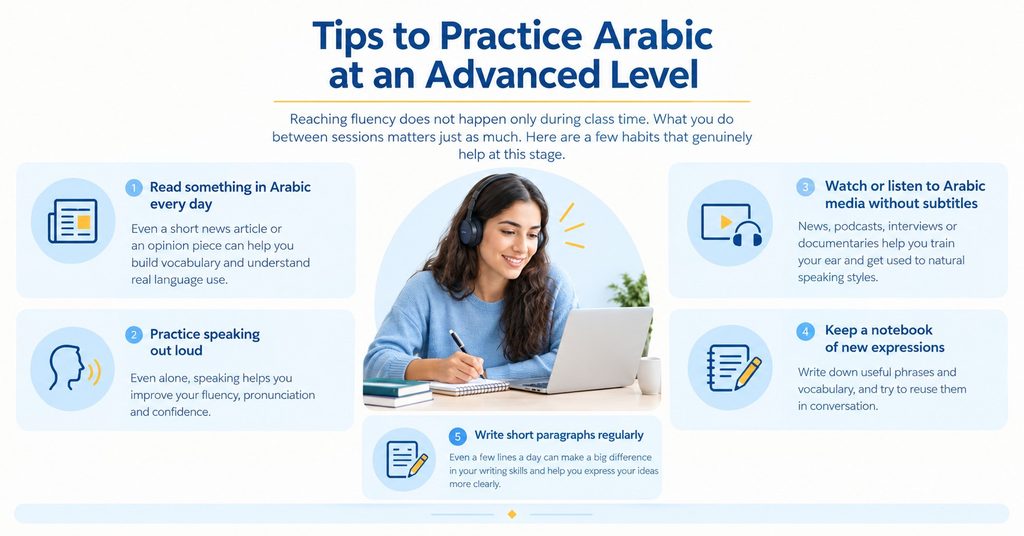
Tips to Practice Arabic at an Advanced Level
Reaching fluency does not happen only during class time. What you do between sessions matters just as much. Here are a few habits that genuinely help at this stage.
- Read something in Arabic every day, even a short news article or an opinion piece
- Practice speaking out loud, even alone, to build fluency and confidence
- Watch or listen to Arabic media without subtitles from time to time to train your ear
- Keep a small notebook of new expressions you come across and try to reuse them in conversation
- Write short paragraphs regularly, even a few lines a day, to strengthen your writing skills
Consistency is far more valuable than intensity. A few minutes of exposure every day will move you forward more than one long session once a week.
It also helps to vary the type of content you engage with. Reading a formal article, listening to an informal conversation, and writing a short reflection all activate different parts of your language skills. Mixing these formats keeps your learning balanced and prevents any one skill from lagging behind the others, which is a common issue for learners who focus heavily on just reading or just speaking.
From Intermediate to Advanced: a Natural Progression
If you are currently at an intermediate stage and wondering whether you are ready to move up, this transition is usually smoother than people expect. Our teachers work closely with learners to identify the right moment to progress, based on real ability rather than a fixed timeline. You can explore what comes right before this stage in our Arabic for intermediate programme, which naturally leads into the advanced course once you are ready.
Why Choose L’arabe maîtrisé
We are a small, dedicated team of two teachers and translators who work remotely and teach Arabic as a foreign language to adults around the world. Every class is live, personal, and adapted to the learner in front of us. We do not use recorded lessons or generic content. Instead, we build each course around real conversation, real feedback, and real progress.
Our goal is simple: to help you reach a level of Arabic where you feel genuinely confident, whether you are writing a professional email, following a debate, or having a natural conversation with a native speaker. If you would like to learn more about who we are and how we teach, you can visit our About Us section.
When you are ready to take the next step, we would be glad to help you find the right class for your level and goals. You can reach out to our team whenever you have questions or want to get started.
Frequently Asked Questions
1. What does an advanced Arabic course actually cover?
It covers refined listening, speaking, reading, and writing skills, along with vocabulary expansion in areas such as media, business, and culture, so you can use Arabic naturally in real situations.
2. Do I need to know Modern Standard Arabic before starting the advanced level?
Yes, our advanced classes assume a solid intermediate foundation in Standard Arabic, since the course builds on grammar and vocabulary you should already be comfortable with.
3. Are the advanced Arabic classes taught live or through recorded videos?
All our classes are taught live on Zoom by one of our teachers. We do not offer recorded courses, so every session includes direct interaction and feedback.
4. How long does it take to reach fluency at this level?
It depends on your starting point and the time you dedicate to practice, but most learners notice real progress within a few months of consistent weekly classes.
5. Is this course focused on a specific Arabic dialect?
No, we teach Modern Standard Arabic, which is understood across the Arabic-speaking world and is the most useful form for professional and formal communication.
6. Can I join if I already speak a dialect but not Standard Arabic?
Yes, many of our learners speak a dialect already and want to build strong Standard Arabic skills for professional or academic purposes.
7. What kind of materials do you use in advanced classes?
We use authentic materials such as news articles, essays and professional documents, along with discussion topics that reflect real conversations and current events.
8. Do your classes include any religious content?
No, we are a secular language centre and our teaching stays focused entirely on the Arabic language and culture, without any religious framing.
9. Who are the teachers behind L’arabe maîtrisé?
We are two teachers and translators who work remotely and specialise in teaching Arabic as a foreign language to adults for personal and professional purposes.
10. How do I know if I am ready for the advanced level?
If you can already hold conversations and read texts at an intermediate level, our team can assess your skills and confirm whether you are ready to move up.