
Many people who want to learn Arabic stop at the same doorway. They have the motivation, the curiosity, and sometimes a cultural connection to the language, but the word “test” makes them hesitate. What will be asked? What if the script looks unfamiliar? What if the result says they know nothing?
An Arabic language assessment is not a pass or fail exam. It is a conversation between you and a teacher about where you are today, so that your first lesson feels comfortable instead of confusing. This guide explains how the tests are built, how scores are worked out, and how to prepare, whether you are starting from zero or returning after a long break. If you are completely new, our Arabic classes for beginners begin with the very first letters, so no prior knowledge is expected.
What an Arabic Language Assessment Actually Is
An assessment is a structured way of measuring what you can already do in Arabic. It looks at how you read, listen, write, and speak, and it gives your teacher a clear picture of your starting point.
We use assessments as a planning tool, not a judgment. The goal is simple: place you in a class where the pace feels challenging but not overwhelming. A learner who is placed too high can lose confidence quickly, and a learner who is placed too low can lose interest just as fast.
We also approach Arabic as a modern language with a rich culture, used in news, business, literature, music, and daily conversation across many countries. That is the outlook behind every assessment at L’arabe maîtrisé, and the questions draw on everyday situations such as introducing yourself, ordering food, or reading a short notice. They do not assume any religious background.
Why Assessments Matter Before You Begin
A good assessment saves time, money, and energy. It also reduces the quiet worry many learners carry into their first lesson. Here is what it helps with:
- Choosing the right level, so lessons match what you already know
- Setting realistic goals based on your current ability
- Spotting gaps early, such as weak listening or uncertain spelling
- Building a learning plan that fits your reasons for studying
- Creating a starting record, so you can see how far you have come later
That last point is often underrated. Progress in a new language can feel invisible from one week to the next. A baseline result gives you something concrete to compare against after a few months of regular practice.
The Main Types of Arabic Tests
Not every test serves the same purpose. Knowing which kind you are facing makes it far less intimidating, so here are the three you are most likely to meet.
Placement Test for Arabic
A placement test for Arabic decides which class suits you. It usually starts with simple questions and becomes more demanding as you answer correctly. When the questions begin to feel difficult, the test has found your approximate level. Struggling at that point is normal and expected, so there is no need to worry about it.
Arabic Proficiency Evaluation
An Arabic proficiency evaluation measures overall ability against a defined scale. Many programmes use six levels, from A1 for absolute beginners to C2 for near native mastery. This kind of evaluation is useful when you need to describe your skills for study, work, or travel plans.
Progress Check
Progress checks happen during a course. They confirm that new material has been understood and highlight topics that need another look. They are shorter and more relaxed than a formal evaluation.
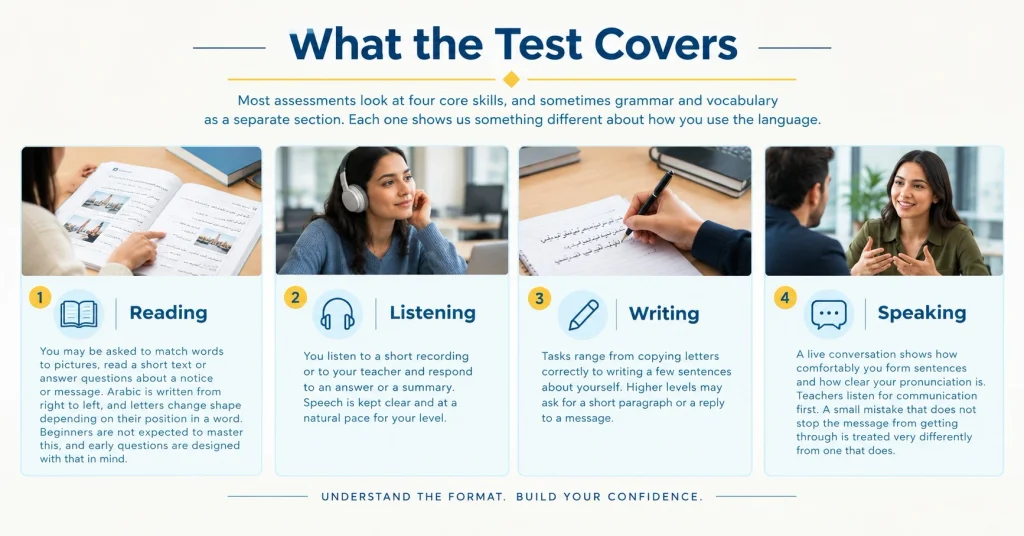
What the Test Covers
Most assessments look at four core skills, and sometimes grammar and vocabulary as a separate section. Each one shows us something different about how you use the language.
Reading
You may be asked to match words to pictures, read a short text or answer questions about a notice or message. Arabic is written from right to left, and letters change shape depending on their position in a word. Beginners are not expected to master this, and early questions are designed with that in mind.
Listening
You listen to a short recording or to your teacher and respond with an answer or a summary. Speech is kept clear and at a natural pace for your level.
Writing
Tasks range from copying letters correctly to writing a few sentences about yourself. Higher levels may ask for a short paragraph or a reply to a message.
Speaking
A live conversation shows how comfortably you form sentences and how clear your pronunciation is. Teachers listen for communication first. A small mistake that does not stop the message from getting through is treated very differently from one that does.
How Arabic Tests Are Scored
Many learners imagine one number that decides everything. In practice, how Arabic tests are scored is more detailed and far more useful. A typical process looks like this:
- Each skill is marked separately, so reading, listening, writing and speaking each receive their own result.
- Responses are measured against level descriptions, which explain what a learner can do at each stage.
- Accuracy, range of vocabulary, fluency and clarity are considered together, not just the number of correct answers.
- The results are combined into an overall level, with notes on strengths and areas to improve.
- Your teacher shares the outcome in plain language and suggests a suitable class.
An uneven profile is common. Someone who has heard Arabic at home may speak with confidence but struggle with reading. Another learner may read well from textbooks but hesitate in conversation. Separate scores make these differences visible, so your lessons can address them directly.
If you are curious about how learning continues once the early foundations are in place, our intermediate levels show what the next steps can look like.
An Arabic Test for Beginners
An Arabic test for beginners is deliberately gentle. You might be asked to recognise a few letters, say a greeting, or tell the teacher whether you have studied before. Many learners who sit this kind of test have never seen the Arabic script, and that is a perfectly good starting point.
Common questions include:
- Have you studied Arabic before, even briefly?
- Can you recognise any letters or numbers?
- Why do you want to learn Arabic?
- Are you more interested in conversation, reading, or both?
Your answers shape the beginning of your course. A learner who wants to travel will focus on useful phrases early, while a learner who wants to read newspapers may spend more time on script and vocabulary.
Which Arabic Is Being Tested?
Arabic has a formal written standard, known as Modern Standard Arabic, and wide spoken varieties that differ from country to country. This surprises many beginners, but it is simply how the language lives, in the same way that spoken English differs from formal writing.
Before the assessment, we ask what you hope to use Arabic for. That helps us decide how much weight to give the standard form and how much to give everyday spoken language. There is no single correct answer. The best focus depends on whether you plan to read, work, travel, or connect with friends and family.
How to Prepare Without Overdoing It
Preparation should be light. You cannot cram for a placement test, and you do not need to. A few small steps are enough:
- Take a quick look at the Arabic alphabet if you are curious, but do not worry if you cannot remember it.
- Think about your goals and be ready to share them.
- Recall any Arabic you have met before, such as words from travel, music or conversations.
- Choose a quiet space and a time when you feel alert.
- Practice saying a few sentences aloud, even if they are simple.
- Be honest during the test and avoid guessing wildly, because accurate placement benefits you most.
Short daily practice, even ten minutes, builds familiarity faster than one long session. The same approach continues after you join, since regular repetition is what makes new sounds and letters feel natural.
Technical Setup for an Online Assessment
Because our classes and assessments take place live online, a few practical details help everything run smoothly:
- Use a laptop or desktop computer, since we share screens and a larger display makes the text clear
- Avoid a mobile phone, where Arabic script is hard to read and shared materials are difficult to follow
- Test your microphone and headphones in advance
- Check that your internet connection is stable
- Keep paper and a pen nearby for notes
A bigger screen matters more than many people expect. Arabic letters include small dots and marks that change a word, so seeing them clearly is part of understanding them.
For learners in private or semi-private classes, we can also arrange sessions at different times of day or on different days from week to week when schedules change. You are always learning live with a teacher, and we simply adapt the timing to your routine.
Common Worries, Answered Honestly
These are the three concerns we hear most often before a first assessment, and each has a simple answer.
What if I know nothing?
Then your result will simply say so, and you will begin with the first steps. Starting from zero is common, and the assessment helps us avoid wasting your time on material you already know.
What if my result is lower than I expected?
A lower level is not a failure. It often means we can build stronger foundations, which makes later progress smoother. Many learners find that a solid base helps them advance faster than skipping ahead.
What if I get nervous?
Nerves are normal, and teachers are used to them. We keep the atmosphere relaxed and begin with easy questions. You can ask for a question to be repeated at any time.
What Happens After Your Assessment
Once your level is clear, we talk through what comes next. You will hear about your strengths, the areas that need attention, and the type of class that fits. We might suggest a group course, a semi-private class, or a private programme, depending on your goals and preferences.
Over time, we recommend repeating a short assessment to check progress. Many learners are surprised by how much they have gained, and seeing it written down is encouraging. If you would like to know more about who we are and how our teachers approach the language, you can read about our team and teaching approach.
Taking the Next Step
An Arabic language assessment should feel like the beginning of a useful conversation, not a hurdle. You have nothing to prove at this stage. You only need to show us where you are, and we will take it from there.
When you are ready to begin the process, you can fill in the pre-registration form, and if you still have questions about levels, timing, or format, you are welcome to reach out to our team.
Frequently Asked Questions
1. What is an Arabic language assessment?
It is a structured review of your reading, listening, writing, and speaking skills in Arabic. The result helps us place you in a class that suits your current level and goals.
2. Do I need to know Arabic to take the assessment?
No. Complete beginners are welcome, and the early questions are designed for people who have never studied the language. Saying that you are starting from zero is a valid and useful answer.
3. How long does a placement test for Arabic take?
Most take between fifteen and thirty minutes, depending on your level. Beginners usually finish more quickly, since the conversation stays simple.
4. How are Arabic tests scored?
Each skill is marked separately and measured against level descriptions. Accuracy, vocabulary, fluency, and clarity are all considered, and you receive an overall level along with feedback on strengths and gaps.
5. Is there a pass or fail result?
No. The assessment places you at a level and does not judge you. Every result leads to a class that fits your starting point.
6. Can I take the assessment on my phone?
We do not recommend it. Our sessions involve shared screens, and the Arabic script is difficult to read on a small display. A laptop or desktop computer works far better.
7. Will the assessment test religious knowledge?
No. We teach Arabic as a modern language with a broad cultural context. The questions focus on everyday communication and general language skills.
8. Which form of Arabic is assessed?
We consider both formal written Arabic and everyday spoken language, depending on your goals. We ask what you want to use Arabic for, then shape the evaluation around that.
9. How should I prepare for an Arabic test for beginners?
Very little preparation is needed. Think about why you want to learn, choose a quiet place, and check your equipment. If you are curious, you can glance at the alphabet, but this is optional.
10. Can I retake the assessment later?
Yes. Many learners repeat a short assessment after several months to measure progress. It helps confirm that your class level still suits you and shows how much your skills have grown.